
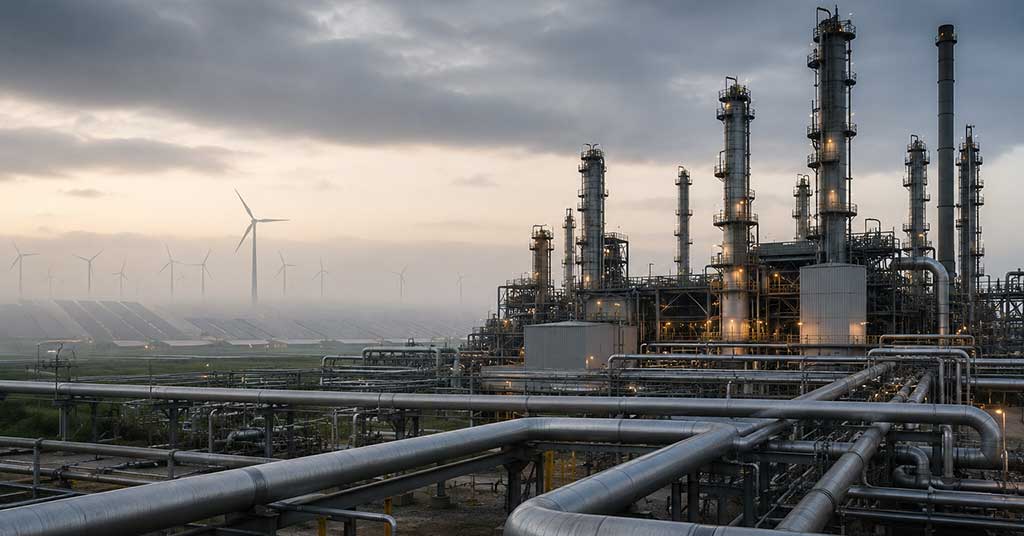
The world is turning back to reliable fossil fuels, fueling massive growth for Canadian crude
The world is quietly abandoning the fantasy that renewables alone can guarantee energy security.
The U.S.-Israel war on Iran exposed how vulnerable the global economy remains to disruptions in fossil fuel supply chains. Any disruption in the Strait of Hormuz quickly affects global fuel prices, inflation and energy costs worldwide.
For years, Western governments pushed rapid decarbonization and a transition away from oil and gas. But war and supply disruptions have exposed how difficult that transition really is. Countries are once again looking to stable producers for reliable fossil fuel supplies.
Oil is once again a precious commodity, and producers are benefiting.
Canada is no exception.
Surging global oil prices, the expansion of export infrastructure like the Trans Mountain pipeline, and improving relations between Ottawa and Alberta on carbon pricing and energy policy are helping drive renewed growth and investor confidence in Canada’s oil sector. Massive resource windfalls and record free cash flows are flowing through the industry.
Canada’s vast reserves and political stability are becoming increasingly important as geopolitical tensions grow. Canada holds the world’s third-largest proven oil reserves, behind only Venezuela and Saudi Arabia.
Policy changes have also made Canada more attractive to long-term investment. Major producers are aggressively returning capital to shareholders through dividends and stock buybacks, while benefiting from narrower discounts for Western Canada Select crude relative to U.S. West Texas Intermediate benchmarks.
Oil and gas companies, which have long argued that federal regulations and environmental policies have crippled industry growth, cautiously welcomed the recent agreement between Ottawa and Alberta. Reuters reported that ConocoPhillips Canada President Nick McKenna said the deal significantly improves the risk profile for oil and gas investment in Canada.
The shift is global.
U.S. oil companies are ramping up production as rising prices revive energy security concerns. Companies, including Diamondback Energy and Continental Resources, are expanding drilling operations.
Veteran oilman Harold Hamm, who owns Continental, told the Financial Times he planned to increase capital expenditures by roughly $300 million to $2.8 billion in 2026 because of higher oil prices.
“We don’t expect prices to go back to where they were prior to the Iran war,” Hamm said.
That marks a dramatic reversal. Earlier this year, Continental planned to halt new drilling in North Dakota because oil prices had fallen below US$60 a barrel. Hamm is now reconsidering that decision.
Publicly traded U.S. shale producers increased their capital spending forecasts by nearly $500 million in first-quarter reports compared to projections issued just three months earlier, according to energy consultancy Enverus.
Low oil prices at the start of the year caused U.S. production to slip to 13.53 million barrels per day in the first quarter, according to the U.S. Energy Information Administration. But soaring prices are now expected to push production to a record 14.21 million barrels per day by the end of next year.
Even Norway, one of the world’s leading advocates for aggressive climate policy and renewable energy, is expanding fossil fuel production again.
Oslo plans to reopen three North Sea gas fields, Albuskjell, Vest Ekofisk and Tommeliten Gamma, by 2028, nearly three decades after they were shut down.
“We will develop, not dismantle, activity on our continental shelf,” Norwegian Energy Minister Terje Aasland recently declared.
Equinor, Norway’s state-owned energy giant, plans to invest US$6 billion annually through 2035 to maintain production levels and prevent output declines.
Norway pumped 2.31 million barrels of oil equivalent per day in the first quarter, nearly nine per cent more than during the same period last year.
Critics argue the policy undermines Norway’s climate goals and delays Europe’s transition away from fossil fuels. Lars Haltbrekken of Norway’s Socialist Left party condemned the move as “greenwashing through and through.”
But the Iran crisis exposed how deeply the world still depends on fossil fuels. Governments are once again turning to dependable producers to protect their economies.
Toronto-based Rashid Husain Syed is a highly regarded analyst specializing in energy and politics, particularly in the Middle East. In addition to his contributions to local and international newspapers, Rashid frequently lends his expertise as a speaker at global conferences. Organizations such as the Department of Energy in Washington and the International Energy Agency in Paris have sought his insights on global energy matters.
Explore more on Energy sector, Energy security, Pipelines, War/Conflict
The views, opinions, and positions expressed by our columnists and contributors are solely their own and do not necessarily reflect those of our publication.
Troy Media empowers Canadian community news outlets by providing independent, insightful analysis and commentary. Our mission is to support local media in helping Canadians stay informed and engaged by delivering reliable content that strengthens community connections and deepens understanding across the country.


That’s a really interesting take, especially considering the current energy market shifts. It makes sense that geopolitical instability would prioritize energy security over rapid decarbonization.
That’s a really interesting take, especially considering the current energy market shifts. It makes sense that geopolitical instability would prioritize energy security over rapid decarbonization.