
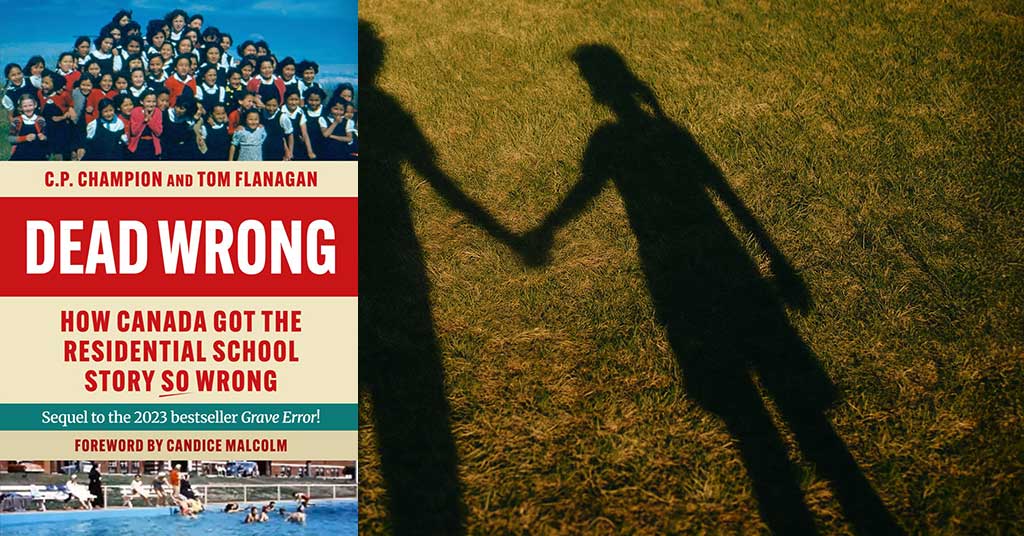
The book Dead Wrong examines how claims about residential schools became accepted in Canada despite a lack of evidence
Title: Dead Wrong: How Canada Got the Residential School Story So WrongEdited by: C.P. Champion and Tom Flanagan
Publisher: True North
Publication Year: 2025
(Available from Amazon)
Canada’s Supreme Court, politicians, academics, legacy media, and Indigenous leaders are promoting falsehoods about Indian residential schools that are dividing Canadians and punishing those who challenge them. This is the central conclusion of Dead Wrong: How Canada Got the Residential School Story So Wrong, edited by C.P. Champion and Tom Flanagan.
Like Grave Error, Dead Wrong dismantles many claims now treated as facts about residential schools. These include assertions that attendance was universally forced, that living conditions were cruel and Dickensian, that cultural genocide was uniform and intentional, and that children were murdered and buried in schoolyards.
Several chapters address living conditions directly. Contributions by Ian Gentles, a historian and professor emeritus at York University; Pim Wiebel, a former policy analyst; and Greg Piasetski, a researcher and consultant specializing in Indigenous policy, show that nutrition, health care, and general living conditions at residential schools were often better than those in students’ homes. This helps explain why many chiefs and parents opposed the federal government’s effort in the 1940s to phase out the schools.
The book defends verifiable evidence against hearsay and intimidation. Frances Widdowson, a former professor at Mount Royal University in Calgary, for example, was physically confronted and berated as a residential school “denier” while speaking on university campuses, as officials responsible for campus safety stood by.
A chapter in Dead Wrong examines her alleged “hate speech” offence, noting there is no proof that Indigenous children were murdered and buried at the Kamloops school or at any other residential school. The Kamloops claim, announced in 2021, was based on ground-penetrating radar findings that identified soil anomalies; to date, no human remains have been excavated or forensically confirmed.
Another contributor, Rod Clifton, professor emeritus of sociology at the University of Manitoba, draws on direct experience. As a student intern in 1966, he lived at Old Sun (Anglican) Residential School on the Siksika First Nation in Alberta, where he met his future wife, Elaine, who is Siksika. Later that year, he served as senior boys’ supervisor at Stringer Hall in Inuvik, N.W.T.
His chapter offers a frank and generally positive account of student treatment at both institutions, while acknowledging that conditions varied from school to school.
Despite this measured scholarship, contributors to Dead Wrong have been publicly labelled as “deniers” by figures associated with the publicly funded National Centre for Truth and Reconciliation and the Assembly of First Nations. Tom Flanagan recounts how, after the wife of the mayor of Quesnel, B.C., recommended Grave Error to friends, two local First Nations demanded the book be condemned as hate speech.
When Widdowson attempted to explain the free speech implications to city council, she was shouted down and told, “You don’t belong here.” The council condemned the book without reading it.
Media conduct is examined in similar detail. CBC Radio’s Unreserved, hosted by Rosanna Deerchild, repeatedly promoted claims about residential schools that are not supported by verifiable evidence, including the assertion of “cultural genocide,” a term popularized by the Truth and Reconciliation Commission.
The commission, which operated from 2008 to 2015, relied primarily on survivor testimony rather than forensic investigation. Parliament later endorsed the term through motions and statements, giving it official political standing and influencing policy, funding, and public debate.
Despite the absence of physical evidence supporting claims of murdered children at Kamloops, the CBC has not issued a formal retraction or apology for asserting that 215 children were secretly buried on the school grounds.
That reporting likely contributed to a public backlash in which more than 110 Canadian churches were burned or vandalized.
In the chapter “The Burning: Canada’s Churches Ablaze,” journalist Cosmin Dszurdzsa documents the lack of urgency shown by law enforcement in prosecuting these crimes and the political indifference of former prime minister Justin Trudeau, who described the attacks as “understandable” in public remarks at the time.
Dead Wrong also examines the role of The Globe and Mail, particularly the work of investigative journalist and columnist Tanya Talaga, in advancing claims not supported by forensic or physical evidence. Neither the newspaper nor Talaga has apologized for reporting claims that, based on available evidence, were wrong.
The suppression of dissent is further illustrated in Widdowson’s chapter on the campaign to rename Powell River, B.C. Critics of the change had their speech restricted, and a public servant was fired for opposing it. The episode reflects the broader treatment of those who question claims advanced by Indigenous leadership.
This narrowing of debate has real consequences that are already visible.
Indigenous and non-Indigenous elites have restricted discussion of residential schools and Indigenous policy. Personal attacks replace evidence, and disagreement is treated as moral wrongdoing. The result is a constrained public discourse that blocks serious discussion of how to improve the lives of Indigenous Canadians.
The evidence presented in Dead Wrong also suggests that some claims lacking evidentiary support are being leveraged for sympathy and financial concessions from other Canadians.
The contributors to Dead Wrong are scholars who have paid a professional price for insisting on verifiable evidence and open debate. Their work deserves engagement, not denunciation. This is a book Canadians should read carefully and assess on its merits.
Our Verdict: ★★★★★
Dead Wrong argues that Canada’s elites have shut down honest debate on residential schools, smeared dissenters, and promoted claims not supported by verifiable evidence, replacing open discussion with censorship and political opportunism.
Peter Best is a retired Sudbury lawyer and the author of There Is No Difference – An Argument for the Abolition of the Indian Reserve System and Special Race-Based Laws and Entitlements for Canada’s Indians. He writes for the Frontier Centre for Public Policy.
Explore more on Aboriginal Politics, Residential Schools, Canadian history, Free speech, Censorship
The views, opinions, and positions expressed by our columnists and contributors are solely their own and do not necessarily reflect those of our publication.
Troy Media empowers Canadian community news outlets by providing independent, insightful analysis and commentary. Our mission is to support local media in helping Canadians stay informed and engaged by delivering reliable content that strengthens community connections and deepens understanding across the country.

